agent.zio.run

AI agents that
explore knowledge
ZIO

Weave scattered data into an ontology, let agents act on a digital twin, and turn it into knowledge you can decide on.

6-stage pipelinePython · JS SDKOn-premises — 12 instances on one machine

Why we built it

Plenty of AI can search and write an answer.
Few can judge and act.

RAG Retrieval-augmented

Chop documents into pieces, scatter them in a vector space, and pull back whatever looks like the question. Fine for searching a manual, but a relation such as "A causes B" falls apart. Facing a question that needs several hops, it shuffles fragments and hallucinates. And it reads everything from scratch on every question.

DAG Decision-augmented — ZIO

Stand the data up as a knowledge graph of objects, relations and properties, and let agents judge → anticipate → predict → act on top of it. A multi-hop question is one graph query answered in 0.1 s. What is learned accumulates. Neural (LLM) meets symbolic (ontology).

How it works

Six steps from data to knowledge

Scroll down — the graph on the left changes with each step.

  1. 01

    Ingest

    Mail, databases, APIs, MCP — scattered sources come in through a pipeline. What has no value is filtered at this threshold.

  2. 02

    Enrich

    Fill in what the source lacked — read a name, company and contact out of an e-mail signature and attach them. Low-density data becomes high-density knowledge.

  3. 03

    Classify

    Sort by predefined criteria. Required, unique and format checks demanded by the schema are enforced here.

  4. 04

    Aggregate

    Find what is common and weave it into objects, relations and properties. From here on the data is a graph, not a table.

  5. 05

    Agent

    Action nodes move: Input → Process → Output. Results are written back into the ontology and become the basis of the next judgement.

  6. 06

    Reason

    Follow causality to find anomalies, simulate, decide. Judgement rather than search — DAG, not RAG.

Three layers of knowledge

Data is not a blunt rock.
It becomes knowledge as it climbs the layers.

3

Discovery layer Dynamic

Read how processes change over time and run virtual simulations to find anomalies. Proposals such as "split the roles this way to remove duplicated resources" come from here.

2

Exploration layer Kinetic

A digital twin bound 1:1 to reality by twin_id. Input → Process → Output action nodes move, and their results are written recursively into the ontology state.

1

Generation layer Semantic

Structure what arrives from mail, databases and APIs into objects, relations and properties; an enrichment pipeline fills what is missing. Required, unique and format checks are enforced at the door.

Real screens

Not mockups. Captured from a running instance.

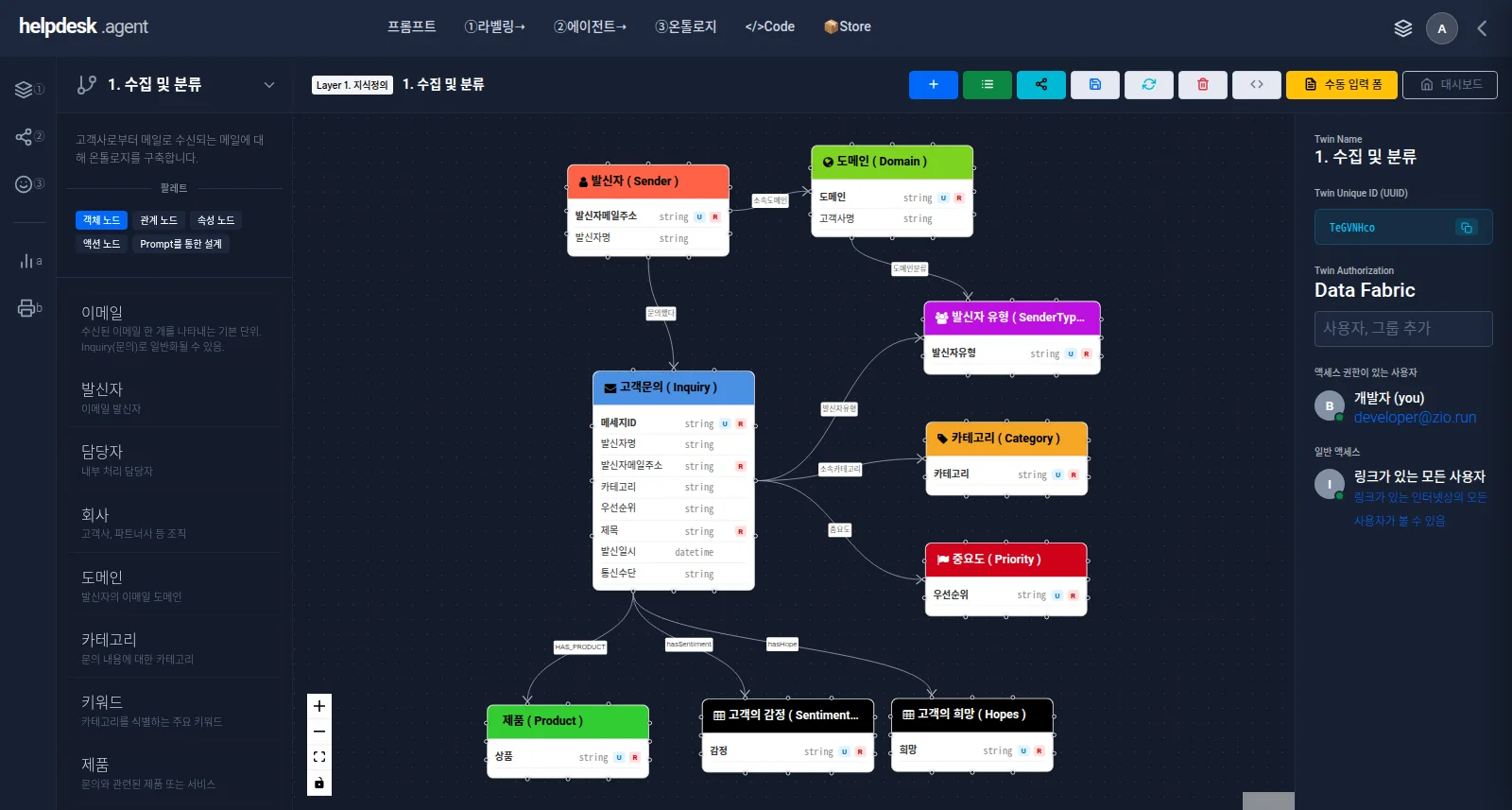
Knowledge schema design

Knowledge schema design

Draw object, relation, property and action nodes to define the ontology. Required, unique and cardinality (1:n) rules are set here and verified when an agent is compiled.

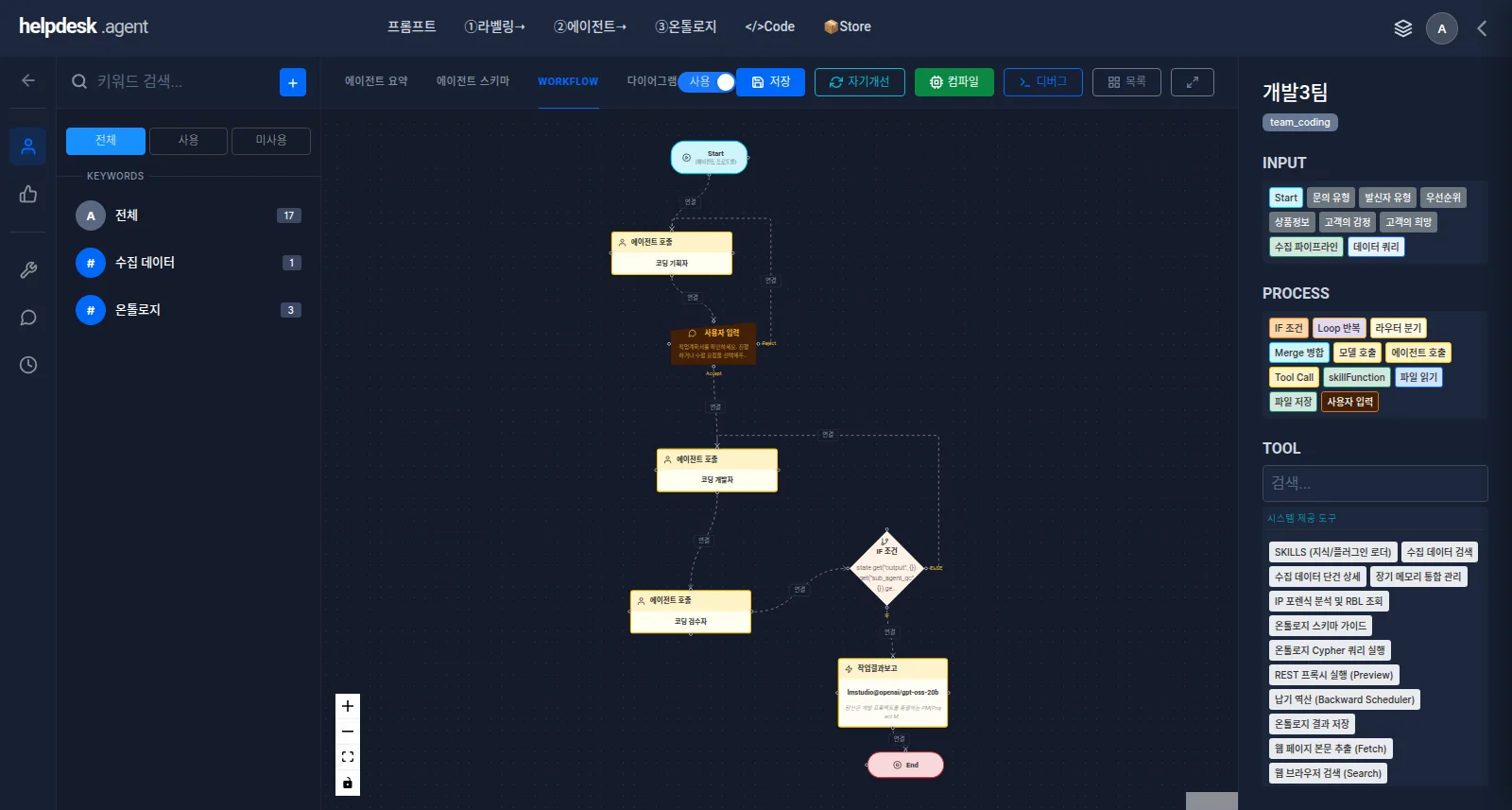
Agent builder

Agent builder

Start, condition, loop, merge, model call, agent call, skill — connect the nodes, compile, and you have LangGraph code. Debug one node at a time.

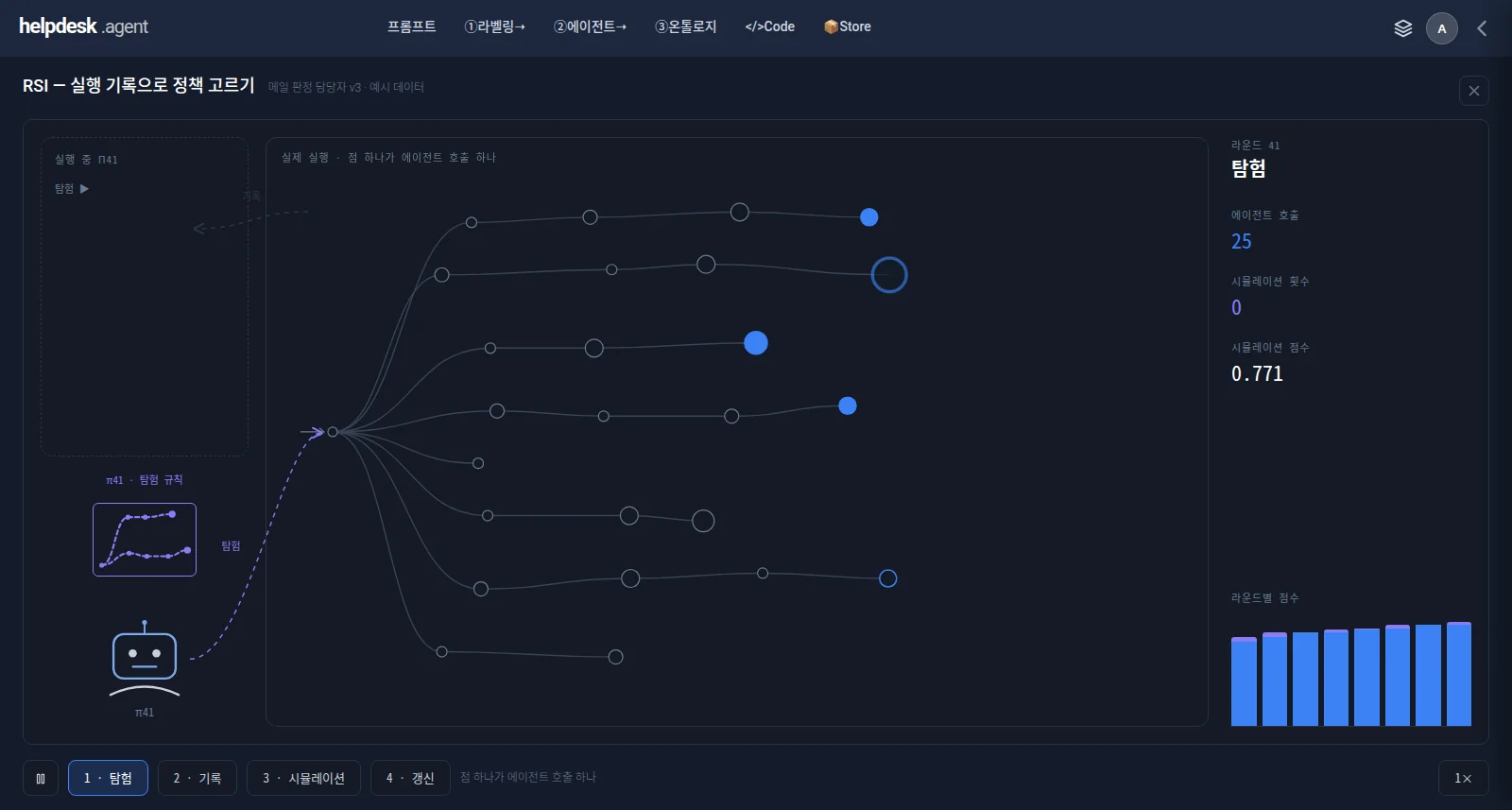
Self-improvement

Self-improvement

Keep execution records, compare policies by simulation, and update to the better one. Explore → record → simulate → update.

Where it runs

Same engine, different jobs

Manufacturing

Automatic production scheduling (APS)

When an order arrives, the BOM is expanded recursively as a graph and equipment utilisation, holidays and due dates are worked backwards into a day-by-day production plan. Against a raw-text approach, the ontology approach led on precise extraction, recursive traversal and reuse alike.

Security

Spam blocking · attachment sanitising

Reported mail arrives over SMTP, is classified and put into the ontology; attachments are sanitised by an isolated CDR worker (ClamAV · YARA · OCR) and returned with a detailed log. Cutting polymorphic leak mail at the session stage with in-memory fuzzy hashing is patent pending.

Support

Customer help desk

Two defect mails from the same customer, hours apart and handled by different people, were tied into one case — because sender, domain, category and priority are connected as relations.
Technology

Your data never leaves the building.

One machine (DGX Spark, 128 GB unified memory) runs one LLM server and twelve instances. An instance is a self-contained world of 12 containers; every customer has their own ontology, their own agents and their own SSH workspace. Models run locally (CUDA · ROCm).

  • Neo4j knowledge graph
  • LangGraph agents
  • FastAPI · React
  • PostgreSQL · MongoDB · Redis
  • Docker MSA
  • Local LLM (LM Studio · vLLM)
  • Python · JS SDK
  • MCP · REST · SMTP ingestion

Patent applications 5

  1. Agentic knowledge exploration with meta-ontology injection — data topology profiles · virtual graph simulation
  2. Agentic RAG with dynamic ontology-schema injection and a multi-angle Cypher ensemble
  3. Agentic AI beyond local-LLM limits through distributed hardware resources and dynamic shared-state workflows
  4. Asymmetric distributed LLM inference on a virtual federation of heterogeneous AI accelerators
  5. Early SMTP-session blocking by in-memory fuzzy hashing and TCP receive control

Learn

FDE training course

Every Friday, four weeks, free. Not theory — you build an agent that solves a real problem from your own workplace: week 1 orientation, week 2 one agent, week 3 an app with the SDK, week 4 a live project. Certificate of completion and the FDE credential.

Want to know if it fits your work?

One e-mail is enough. Tell us what data you have and what you need to decide.